

Most wallet failures do not begin with a stolen private key. They begin with a transaction the user did not fully understand. That is the counterintuitive reason a browser wallet should be judged less by how quickly it connects to a dApp than by how clearly it explains what signing will change. For German-speaking DeFi users, the practical question behind “Rabby Chrome Extension” or “Rabby installieren” is therefore not simply whether the software is convenient. It is whether convenience can be combined with meaningful transaction review across a fragmented EVM ecosystem.
Rabby is a non-custodial wallet developed by DeBank for DeFi use. It is positioned as an alternative to MetaMask, with a stronger emphasis on multi-chain workflows, security warnings, and transaction simulation. The distinction matters: Rabby does not take custody of funds, and its core signing process is designed to remain usable even if Rabby’s own backend services are unavailable. That architecture creates useful safeguards, but it does not remove the need for user judgment.
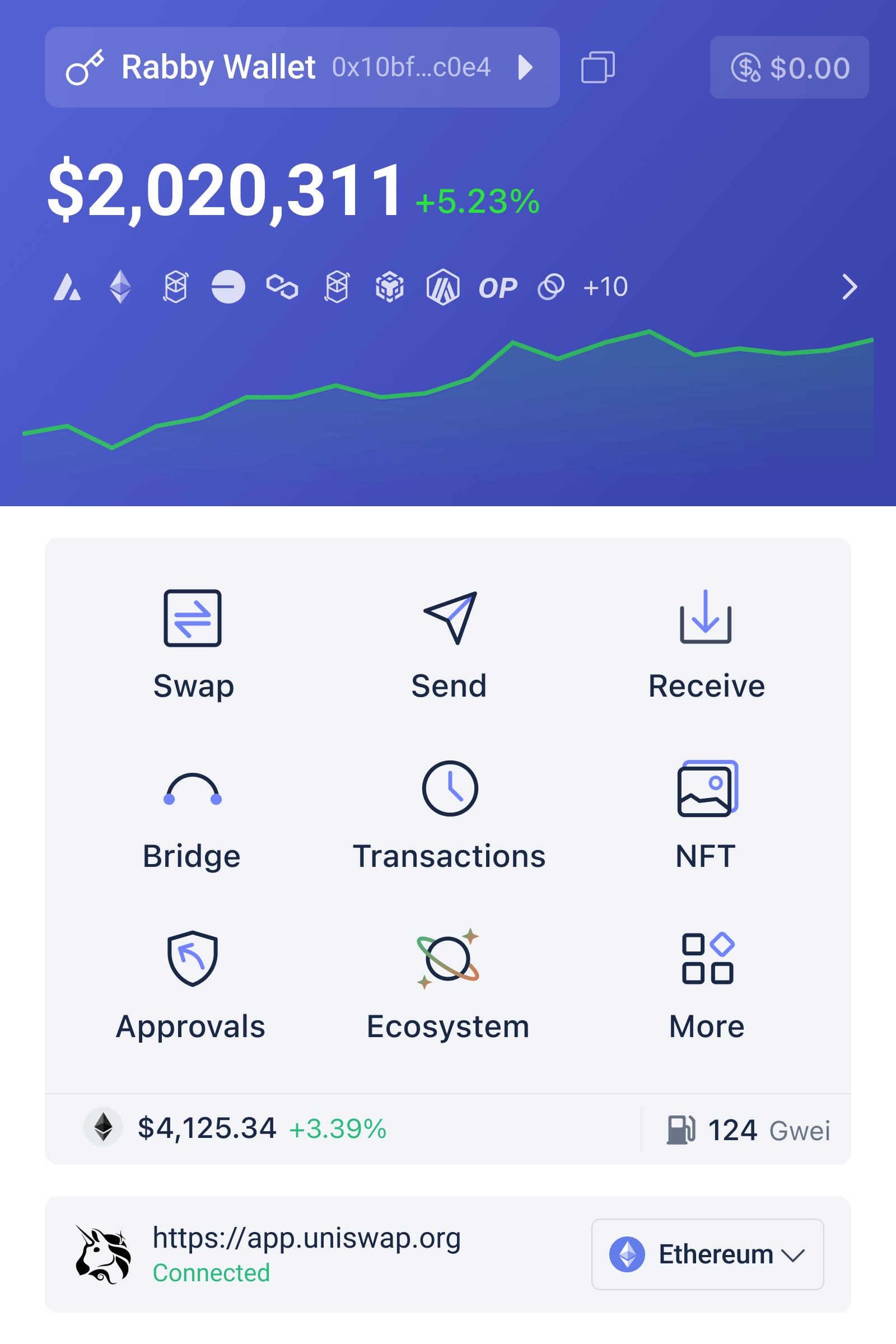
Why the Rabby extension is more than a network switcher
A conventional mental model treats a wallet as a digital keyring. That description is incomplete for modern DeFi. A wallet is also an interface between a human decision and an on-chain program. When a user connects to a lending market, decentralised exchange, bridge, or NFT application, the critical issue is not only which address will sign. It is what permissions, token movements, contract calls, and network fees the transaction will create.
Rabby’s central contribution is to place more interpretation between the dApp interface and the final signature. Its transaction simulation is intended to show expected changes in token balances before approval. In practical terms, this can expose a mismatch between a user’s intention and a contract call: for example, a swap that produces an unexpected asset flow, or an approval that grants a contract broader spending authority than the user anticipated.
This is an important conceptual distinction. Simulation is not the same as prediction in the everyday sense. It does not prove that a smart contract is honest, economically sound, or safe after the transaction is confirmed. It represents an attempted execution under available conditions. State changes, oracle behaviour, liquidity, gas conditions, and contract logic can still produce outcomes that a user should evaluate independently.
The integrated security engine adds another layer by checking contracts and addresses for signals associated with phishing, known exploits, or unlimited token approvals. Such warnings are valuable because humans are poor at recognising malicious addresses and complex calldata by inspection. Yet a warning system is best understood as a filter, not a guarantee. A new exploit may not be known, a legitimate contract may still contain economic risk, and an absence of a warning should never be interpreted as certification.
Rabby installieren: what the installation decision really involves
For users searching for a Rabby wallet extension for Chrome, the first principle is source verification. Browser extensions should be installed from the official distribution channel and checked carefully for the correct publisher, because phishing copies can imitate names, logos, and descriptions. Recent Chrome Web Store information presents Rabby as an open-source Ethereum and EVM wallet designed for a smoother multi-chain DeFi experience. That description is useful context, but the store listing itself should not replace cautious installation practice.
After installation, the security boundary is local. Rabby states that private keys are stored on the user’s device and are not sent to Rabby’s servers. This is a major advantage over custodial arrangements, but it also transfers responsibility to the user. A seed phrase is not a password-reset mechanism controlled by a company. If it is exposed, copied into a fraudulent website, photographed, or stored in an insecure cloud account, the non-custodial design cannot undo the damage.
For meaningful holdings, hardware-wallet support can improve the separation between browsing and signing. Rabby integrates with devices such as Ledger, Trezor, and OneKey. The hardware device does not make a malicious transaction harmless; rather, it makes key extraction more difficult and adds a physical signing step. The user must still inspect the transaction and understand the device’s prompts. Security is layered, not outsourced.
Multi-chain convenience creates a new class of mistakes
Rabby supports more than 140 EVM-compatible networks, including Ethereum, Polygon, Arbitrum, Optimism, Avalanche, Base, and BNB Chain. Automatic network switching can remove a common source of friction: manually selecting the correct chain before connecting to a dApp. Its bridge integrations, including LI.FI, and its swap functionality, which scans decentralised venues such as Uniswap and 1inch, further consolidate actions that would otherwise require several interfaces.
But consolidation has a trade-off. The easier it becomes to move assets across networks, the easier it is to forget that networks are separate economic and technical environments. The same token symbol may represent different contracts on different chains. Bridge transactions add counterparty, routing, liquidity, and smart-contract dependencies. A displayed route with low expected slippage is not automatically the lowest-risk route.
The same reasoning applies to the Gas Account feature, which can allow fees to be paid with stablecoins such as USDC across networks when the user lacks the native gas token. This solves a genuine usability problem, especially for newcomers moving between Layer 2 networks. However, fee abstraction can hide the operational model: users should know which service converts or sponsors the payment, what costs apply, and whether the feature is available for the specific transaction and network.
A useful rule for German DeFi users is to separate three questions before signing: “Is this the correct chain?”, “Is this the correct asset and contract?”, and “Is this the economic outcome I actually want?” Automatic switching mainly helps with the first. Simulation and warnings can assist with the second. Neither can fully answer the third, which depends on liquidity, price impact, protocol incentives, collateral risk, and the user’s own strategy.
For more information, visit rabby wallet.
Myths versus reality
Myth: transaction simulation makes DeFi safe
Reality: simulation improves visibility. It can make expected balance changes and approval effects easier to inspect, reducing avoidable errors. It cannot establish that a protocol will remain solvent, that an oracle will behave correctly, or that a bridge will not be compromised later.
Myth: open source means the wallet has no security risk
Reality: Rabby’s MIT-licensed open-source architecture allows the code to be examined by the community, which supports transparency and independent review. Open source is a governance and auditability property, not a promise that every vulnerability has been found or that the installed browser environment is uncompromised.
Myth: non-custodial means risk-free ownership
Reality: non-custodial means the user controls the keys. That reduces dependence on a central custodian but increases the importance of endpoint security, seed-phrase handling, phishing resistance, and transaction discipline.
These distinctions explain why Rabby’s strongest value is not a single feature. It is the combination of local key control, independent transaction signing, pre-signing simulation, risk scanning, hardware compatibility, and a multi-chain interface. Each layer addresses a different failure mode. None substitutes for the others.
What to watch as the wallet model evolves
The direction of travel is clear even if the outcome is not. Wallets are becoming transaction interpreters rather than passive key managers. If simulation quality, contract intelligence, and clearer permission controls improve, users may make fewer elementary signing mistakes. That would be especially significant as applications spread across rollups, app-specific chains, and cross-chain routing systems.
The open question is how much interpretation should be delegated to the wallet. More automation reduces cognitive load, but it can also encourage users to approve unfamiliar actions because the interface looks reassuring. The strongest future design would therefore expose uncertainty, not merely produce a green approval signal: what was simulated, under which assumptions, which permissions remain active, and what risks were not assessed.
Rabby Points, earned through activities such as swaps, gas top-ups, or referrals, introduce another behavioural consideration. Loyalty systems may make a product more engaging, but rewards can also encourage unnecessary transactions. In DeFi, a points incentive should be evaluated against gas costs, slippage, smart-contract exposure, and tax-record complexity in Germany. A reward is not automatically a return.
Frequently asked questions
Is Rabby available as a Chrome extension?
Yes. Rabby is primarily available as a browser extension for Google Chrome, Brave, and Edge. It also offers desktop versions for Windows and macOS and mobile applications for iOS and Android. Users should verify the official publisher and distribution source before installing.
Does Rabby store my private keys on its servers?
According to its non-custodial design, private keys are stored locally on the user’s device and are not transmitted to Rabby’s servers. This means Rabby cannot recover a lost seed phrase for the user. Secure backups and careful protection against phishing remain essential.
Can Rabby’s simulation detect every malicious transaction?
No. Simulation and security scans can reveal expected balance changes, suspicious approvals, and known risk signals, but they cannot guarantee that a contract, bridge, token, or protocol is safe. Users should treat the result as decision support rather than an approval certificate.
Is Rabby a good alternative to MetaMask?
It may be particularly suitable for users who regularly interact with several EVM networks and want stronger transaction-context information before signing. The choice depends on workflow, hardware-wallet needs, supported applications, and personal tolerance for managing a non-custodial setup.
The most accurate way to view Rabby is neither as a magic security shield nor as merely another browser wallet. It is a transaction-review system built around local key ownership and multi-chain DeFi access. For users considering Rabby installieren, the practical test is simple: does the interface help you pause, inspect, and understand what will happen before the signature leaves your device? If it does, Rabby can meaningfully improve the quality of decisions. The responsibility for those decisions, however, remains exactly where non-custodial finance places it: with the user.
