

A common misconception is that a crypto wallet is mainly a digital keyring: install an extension, copy an address, and approve whatever a decentralised application requests. That model breaks down quickly in DeFi. A single click can involve token approvals, routing contracts, bridges, several networks, and fees that are difficult to interpret from a wallet prompt alone. For a user in Germany moving between Ethereum, Arbitrum, Base, Polygon, or other EVM networks, the important question is not simply whether a wallet supports many chains. It is whether the wallet helps explain what a signature will actually do.
That is the central idea behind Rabby. Its strongest differentiator is not the number of networks listed in a menu, but the attempt to turn an opaque signing event into an inspectable state change. Rabby is a non-custodial wallet developed by DeBank for DeFi users, available primarily as a browser extension and also through desktop and mobile applications. Recent visibility in the Chrome Web Store has reinforced that positioning: an open-source wallet for Ethereum and EVM networks with a multi-chain focus. Yet security features should be understood as risk-reduction mechanisms, not as guarantees.
A practical case: the harmless-looking swap
Imagine a user wants to swap USDC for ETH before supplying the result to a lending protocol. The user connects a wallet, selects a route, and sees a familiar request to sign. In a conventional mental model, the action is simply “swap.” Technically, however, the transaction may authorise a contract to spend tokens, call an aggregator, interact with a liquidity venue, and return a different balance after fees and slippage. If the user later forgets about the approval, the permission may remain active even though the swap itself is complete.
Rabby’s transaction simulation addresses this gap before signing. It attempts to show the expected changes to token balances and the resulting position, rather than presenting only raw calldata or a contract address. This distinction matters because a transaction can be valid at the protocol level while still being economically wrong for the user. A simulation may reveal that the recipient balance decreases, that an unexpected asset is involved, or that an approval is broader than the immediate trade appears to require.
Simulation is therefore best understood as a preview of state transition. It does not predict the future in an absolute sense; it estimates what should happen under the current chain state and transaction parameters. Prices can move, liquidity can change, an oracle can update, a contract can behave differently under another condition, or the simulation service itself can be incomplete. The useful question is not “Did Rabby say this is safe?” but “Does the proposed result match my intention, and are the remaining uncertainties acceptable?”
What the Rabby Chrome extension changes in daily use
For many German-speaking DeFi users, the browser extension is the natural entry point. Those searching for a rabby wallet extension should still verify the official distribution channel and the publisher before installing anything. Phishing pages often imitate wallet branding, and the security of a non-custodial wallet begins with obtaining the software from a trustworthy source. No transaction simulator can repair a compromised installation or a stolen recovery phrase.
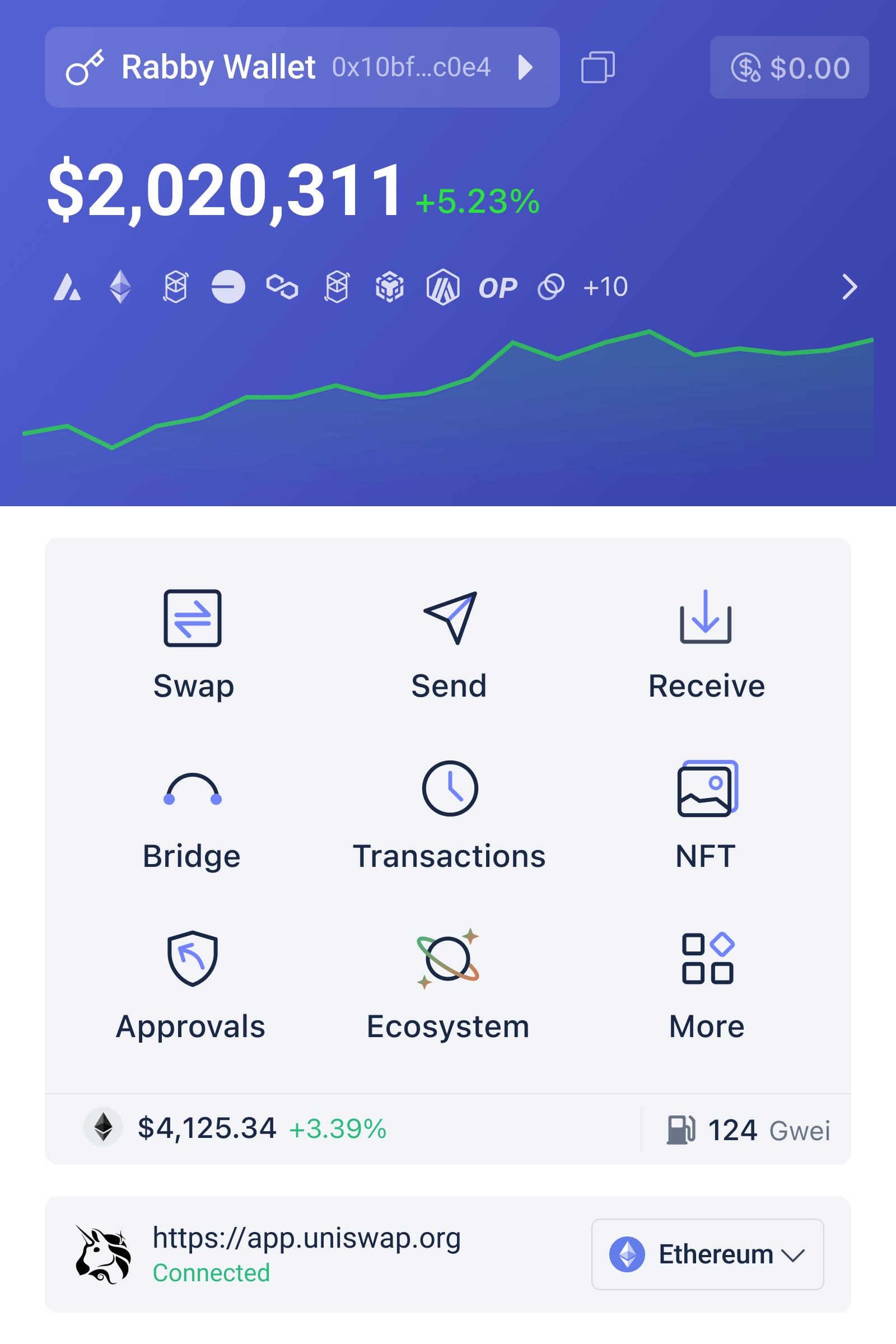
Once installed, Rabby is designed to reduce several sources of friction. It can detect the network required by a decentralised application and switch automatically, rather than forcing the user to change networks manually. It supports more than 140 EVM-compatible networks, including Ethereum, Polygon, Arbitrum, Optimism, Avalanche, Base, and BNB Chain. That breadth is convenient, but it also creates a subtle danger: the easier it becomes to move between networks, the easier it is to lose track of where assets, approvals, and positions actually reside.
The integrated security engine adds another layer of inspection. It checks contracts and addresses for signals associated with phishing, known compromises, and potentially dangerous unlimited approvals. This is valuable because address poisoning and malicious token permissions exploit human attention rather than cryptographic weakness. Still, scanners depend on available intelligence and recognisable patterns. A new or poorly documented contract may not produce a warning, while a warning itself may require interpretation rather than automatic rejection.
Multi-chain convenience has a price
Rabby includes a swap aggregator that can compare routes through decentralised exchanges such as Uniswap and 1inch. In principle, scanning several venues can improve execution and reduce unnecessary slippage. But the best quoted route is not always the best practical route. A user should also consider gas costs, execution complexity, approval requirements, liquidity depth, and whether the route introduces an unfamiliar contract.
The same trade-off appears in bridging. Integrations such as LI.FI allow assets to be moved across networks from within the wallet interface. This can make a fragmented ecosystem more usable, but a bridge transaction is not merely a network switch. It may involve a source-chain contract, a liquidity provider, a destination-chain transaction, and additional failure modes. A clean interface can hide that complexity, which is precisely why simulation and careful review remain important.
Gas Account functionality offers another convenience: users may be able to pay network fees with stablecoins such as USDC across networks, even when they do not hold the native gas token. This solves a familiar practical problem, especially when funds are distributed across several chains. It does not eliminate fees or guarantee that every transaction can be sponsored or settled as expected. Stablecoin payment may also introduce conversion, availability, or service-dependency considerations. Convenience changes the workflow; it does not repeal the underlying economics of blockchains.
Rabby compared with common alternatives
Rabby and MetaMask
MetaMask remains a widely recognised general-purpose gateway to Ethereum and EVM applications. Its advantage is familiarity and broad ecosystem recognition. Rabby’s emphasis is different: richer transaction previews, multi-chain orientation, automatic network handling, and more prominent risk warnings. The practical choice depends on workflow. Someone who mainly uses a small number of established applications may value MetaMask’s ubiquity, while a user frequently moving across EVM chains may benefit from Rabby’s review-oriented interface.
Rabby and hardware wallets
A Ledger, Trezor, or OneKey device protects private-key operations by keeping signing material in dedicated hardware. Rabby does not replace that security model; it can work as the interface through which a compatible hardware wallet reviews and signs transactions. This combination separates two jobs: Rabby can improve the readability of a DeFi request, while the hardware device adds a stronger boundary around the key. The cost is more setup and, depending on the application, occasional compatibility friction.
Rabby and a basic self-custody wallet
A simpler wallet may expose fewer warnings and fewer integrated routes, but that can also mean fewer moving parts. Rabby offers swaps, bridging, gas-related tools, points, and broad network support in one environment. Those features are useful for active DeFi participants, yet every integration expands the surface that must be understood and maintained. A wallet with more automation is not automatically safer than a minimal one; it is safer only when the user understands what the automation is doing and retains the ability to stop.
The boundary between assistance and responsibility
Rabby stores private keys locally under a non-custodial model, rather than sending them to Rabby’s servers. Its open-source architecture, released under the MIT licence, also allows the community to inspect the software. These are meaningful properties, but neither removes operational responsibility. The recovery phrase remains decisive. A malicious browser extension, an unsafe backup, a fake support message, or a careless signature can still defeat a technically strong wallet.
Rabby also describes itself as an independent checking layer: it does not invent or alter the user’s transactions, and core signing functions can remain available even if Rabby backend services experience an outage. That separation is conceptually important. A wallet interface can explain a transaction, but the blockchain contract ultimately determines the result. Users should treat simulations and warnings as evidence to evaluate, not as an insurance policy.
A reusable decision rule is simple: first identify the asset leaving your wallet, then identify the permission being granted, then identify the contract and network involved, and finally compare the expected result with the purpose of the action. If one of those four elements is unclear, pause. This habit is more durable than memorising any particular wallet brand.
What to watch next
The direction of travel is clear even if the outcome is not. As DeFi spreads across more EVM networks, wallet interfaces will increasingly compete on interpretation rather than mere connectivity. Transaction simulation, approval warnings, route comparison, and cross-chain fee abstraction could make advanced activity less error-prone. The open question is whether these systems can remain transparent as transactions become more composable, or whether convenience will simply conceal more layers behind a polished screen.
For a German user comparing wallets today, Rabby is most compelling when the goal is active, multi-chain EVM use with a stronger pre-signing review process. It is less compelling as a reason to stop thinking critically. The genuinely useful feature is not that the wallet promises safety; it is that it gives the user more information before an irreversible decision. That extra moment of clarity is small, but in DeFi it can be the difference between executing an intended strategy and approving an entirely different one.
Frequently asked questions
Does Rabby transaction simulation guarantee that a transaction is safe?
No. Simulation shows the expected outcome under the conditions available at the time of review. It may not capture every contract behaviour, future price movement, oracle update, or novel exploit. Use it as a decision aid alongside contract, recipient, approval, and network checks.
Is Rabby a custodial wallet?
No. Rabby is designed as a non-custodial wallet, with private keys stored locally on the user’s device rather than sent to Rabby’s servers. The user remains responsible for the recovery phrase, device security, and every signature.
Can Rabby replace a hardware wallet?
It can serve as a DeFi interface, but it does not provide the same key-isolation model as a dedicated hardware wallet. Rabby supports hardware wallets such as Ledger, Trezor, and OneKey, allowing users to combine clearer transaction review with separate signing hardware.
