

A common misconception in DeFi is that the best wallet is simply the one connected to the largest number of networks. More chains, more integrations and fewer manual steps certainly sound convenient. Yet every additional chain also adds another contract environment, bridge route, fee market and opportunity for user error. The real question is therefore not whether a wallet supports many networks, but whether it helps the user understand what a transaction will do before signing it.
That distinction explains the appeal of Rabby among Ethereum and EVM users. Its design is aimed less at being a passive key holder and more at acting as a transaction-awareness layer between a decentralised application and the person approving an action. For German-speaking DeFi users comparing a rabby chrome extension, a traditional browser wallet or a hardware-wallet workflow, the important feature is not convenience in isolation. It is how convenience is balanced against verification, custody and operational risk.
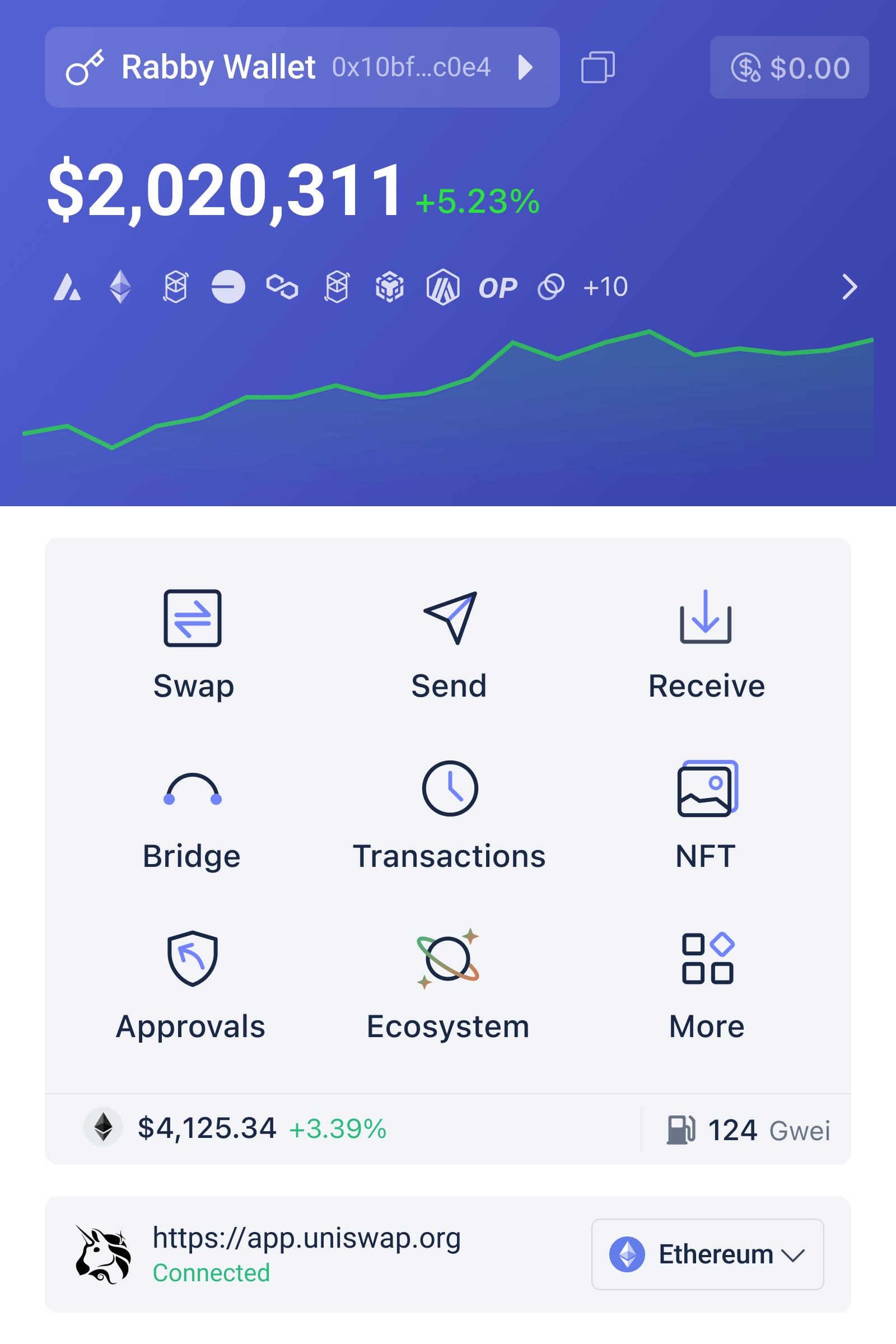
What Rabby actually changes in the wallet experience
Rabby is a non-custodial wallet developed by DeBank for DeFi use. Non-custodial means that the private keys remain under the user’s control and are stored locally on the device rather than being handed to Rabby’s servers. The wallet does not take custody of funds or independently execute transactions on the user’s behalf. It prepares and presents transaction information; the user, or a connected hardware wallet, still has to authorise the signature.
This matters because a wallet interface can influence behaviour without controlling assets. A familiar “Confirm” button may hide whether a user is swapping tokens, granting a broad approval, interacting with an unfamiliar contract or moving funds through a bridge. Rabby’s central idea is to expose more of that context. Before signing, it performs a transaction simulation that estimates the expected changes to token balances. It also uses a security engine to flag issues such as phishing indicators, known compromised contracts and potentially dangerous infinite approvals.
The simulation should not be misunderstood as a guarantee. It is an informed preview based on the state and assumptions available at the time of checking. Blockchain state can change between simulation and confirmation, contracts can contain logic that is difficult to interpret, and a warning system cannot identify every new or deliberately deceptive attack. Its value is comparative: a visible, plausible result is usually more useful than signing a request whose consequences are opaque. The final responsibility still lies with the signer.
For readers who want to examine the available installation route, the https://sites.google.com/kryptowallets.app/rabby-wallet-extension-app/ provides a direct starting point. In practice, users should still verify that they are downloading the genuine application or extension and should never enter a recovery phrase into a website claiming to “activate” the wallet.
Why multi-chain support creates both value and risk
Rabby supports more than 140 EVM-compatible networks, including Ethereum, Polygon, Arbitrum, Optimism, Avalanche, Base and BNB Chain. EVM refers to the Ethereum Virtual Machine, the execution environment used by Ethereum and many compatible networks. A single wallet interface can therefore manage activity across several ecosystems while automatically switching to the network requested by a connected decentralised application.
That automatic switching removes a common source of friction. A user moving between Ethereum mainnet and a layer-2 network does not necessarily need to change the network manually each time. But the same feature can create a subtler risk: reduced friction may reduce attention. If a user sees the right token and the right application but does not notice the active chain, a transaction can still be misunderstood. Convenience is safest when it removes repetitive work, not when it removes the moment of deliberate verification.
The same trade-off appears in cross-chain transfers. Rabby integrates bridge protocols such as LI.FI, allowing users to move assets across networks from within the wallet interface. This is operationally simpler than visiting several separate bridge applications. It does not eliminate bridge risk, however. A cross-chain transfer depends on the selected route, the underlying bridge or liquidity venue, token representations, fees and the security assumptions of more than one network. A clean interface cannot compress those risks into zero risk.
Rabby’s swap function similarly scans decentralised exchanges such as Uniswap and 1inch to seek competitive rates and lower slippage. Slippage is the difference between the expected and executed exchange price. Aggregation can improve execution, but “best rate” is not the same as “best outcome”. Users should consider price impact, approval requirements, route complexity, gas costs and the trust assumptions of every contract involved. A slightly better quote may not justify a more complicated transaction path for a large or sensitive position.
Gas abstraction: useful design, not free money
One of Rabby’s more practical features is its Gas Account, which can allow users to pay network fees with stablecoins such as USDC rather than holding the native token of each chain. This addresses a familiar DeFi problem: assets may be present in a wallet, but a small amount of ETH, MATIC or another native token is still needed to make a transaction.
Paying gas in a stablecoin makes the wallet easier to use, particularly for someone operating across several EVM networks. It also changes the user’s mental model. The underlying network still requires its native asset to process the transaction; the feature is an abstraction layer that handles the conversion or fee settlement mechanism. Users should therefore inspect the quoted cost and understand any service conditions rather than assuming that native-token economics have disappeared.
This is a useful general rule for evaluating wallet features: abstraction reduces operational complexity, but it does not remove the system underneath. The bridge still has bridge assumptions, the swap still has execution risk, and stablecoin-based gas still depends on the mechanism that converts the user’s balance into a valid network fee.
How Rabby compares with common alternatives
Against MetaMask
MetaMask remains a familiar general-purpose gateway to Ethereum and many EVM applications. Its strength is broad recognition, extensive dApp compatibility and a large user community. Rabby’s distinction is its DeFi-oriented presentation: pre-signing simulations, more prominent warnings, automatic network selection and a workflow designed around multi-chain activity. For a user who mainly holds assets and occasionally connects to one trusted application, MetaMask may be sufficient. For someone constantly moving between lending markets, decentralised exchanges and layer-2 networks, Rabby’s additional context may be more valuable.
Against a hardware wallet alone
Ledger, Trezor and OneKey protect signing keys in dedicated hardware, which is a strong defence against many forms of malware on a computer. They do not automatically explain every smart-contract interaction, though. A hardware device can securely sign a malicious transaction if the user approves it. Rabby can serve as the analysis and interface layer while the hardware wallet remains the signing authority. This combination separates two questions: “What am I signing?” and “Where is the key stored?” Strong security requires attention to both.
Against a mobile-first wallet
Mobile wallets are convenient for users who trade or monitor positions while away from a desktop. Rabby is available on mobile as well as through browser extensions, desktop versions for Windows and macOS, and browsers such as Chrome, Brave and Edge. The browser-extension workflow is particularly relevant for complex DeFi dashboards, where transaction details, network status and contract warnings benefit from a larger screen. The trade-off is that browser environments expose users to phishing pages, malicious extensions and compromised devices, making download hygiene and device security essential.
What the security model can and cannot promise
Rabby’s open-source architecture, released under the MIT licence, allows the code to be examined by the community. That is a meaningful transparency property, but open source is not identical to a formal safety guarantee. Code can contain bugs, reviews can miss interactions, and the installed software must still be obtained from a legitimate source. Likewise, local key storage improves control over custody but does not protect a user who loses the recovery phrase, approves a malicious transaction or operates an infected device.
The wallet’s stated independence from its backend is also important. Rabby functions as an independent verifier rather than changing transactions behind the scenes, and core signing capabilities can remain available even if Rabby services experience an outage. Yet some contextual features, simulations or data services may depend on external information. The practical lesson is to distinguish between the ability to sign and the quality of the information available before signing.
Users in Germany should also keep records of transactions, swaps, bridge movements and rewards. Rabby Points, earned through actions such as swaps, gas top-ups or referrals, may make the product more engaging, but points should not become a reason to transact unnecessarily. From a financial and tax perspective, the underlying transaction matters more than the interface label. A reward programme can encourage activity precisely when restraint may be the better risk decision.
A practical decision framework for DeFi users
Before approving a transaction, ask four questions. First, is the active network the one intended? Second, does the simulation show the expected asset movement, including approvals or new spending permissions? Third, is the contract or bridge route appropriate for the size and purpose of the transaction? Fourth, is the signing device suitable for the value at risk?
This framework is deliberately simple because complexity often causes users to skip checks. For everyday, low-value activity, a browser wallet with simulation and warnings may offer a sensible balance. For larger holdings, pairing Rabby with a hardware wallet adds a separate key-protection boundary. For experimental protocols or newly launched tokens, neither simulation nor open source should be treated as proof of safety; a small test transaction and limited approval may be more rational than trusting a polished interface.
The near-term question is whether wallets will increasingly compete on transaction interpretation rather than mere connectivity. If multi-chain activity continues to expand, users will need tools that translate contract calls, routing decisions and permission changes into understandable consequences. That direction is plausible because the basic problem is structural: more networks create more choice, and more choice creates more room for mistakes. The winning design will not be the one that hides complexity most effectively, but the one that reveals the right complexity at the right moment.
Frequently asked questions
Is Rabby safer than MetaMask by default?
Not automatically. Rabby provides stronger transaction context through simulation and security warnings, which can reduce certain user errors. However, safety still depends on the legitimacy of the application, the user’s device, key management, approval decisions and the contracts being used. A warning system improves informed decision-making; it does not guarantee a safe outcome.
Can Rabby pay gas without native tokens?
Its Gas Account feature can enable fees to be paid with stablecoins such as USDC across supported networks. The underlying network still requires a valid fee mechanism, so users should review the quoted amount and conditions. The feature removes the need to manually maintain every native token, but it does not remove transaction costs.
Should valuable assets be kept in a browser wallet?
For substantial holdings, many users prefer a hardware wallet connected to the DeFi interface. Rabby supports hardware wallets including Ledger, Trezor and OneKey, allowing the browser interface to provide context while the separate device protects signing keys. Even then, users must verify the transaction details and protect the recovery process.
